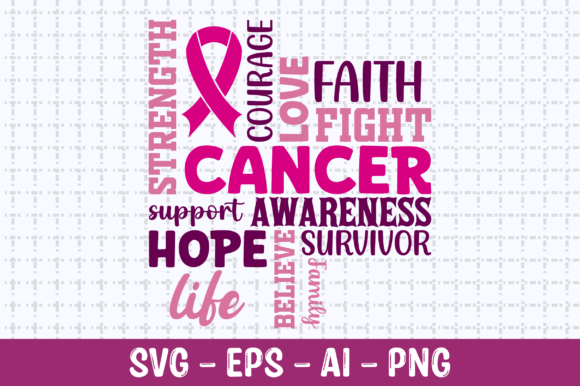
Cancer Awareness Support Survivor SVG
First Impressions: A Design That Speaks Before a Single Stitch
When I opened the Cancer Awareness Support Survivor SVG for the first time, I didn’t reach for my embroidery machine—I paused. It’s clean, centered, and quietly powerful: a ribbon motif interwoven with subtle text like “Survivor” or “Support,” often paired with soft botanical flourishes or minimal linework. There’s no clutter, no forced sentimentality—just quiet strength in its proportions and spacing. As a designer who’s stitched hundreds of awareness-themed pieces for clients, I immediately sensed this wasn’t made for mass-printed slogans. It’s built for intention—like embroidering a linen tote bag for a local support group fundraiser, or personalizing a baby blanket for a family navigating diagnosis.
Where This Design Finds Its Truest Purpose
The Cancer Awareness Support Survivor SVG shines brightest on projects where meaning meets tactility. Think: a heavyweight cotton apron for an oncology nurse’s boutique shop, a loop-woven tea towel gifted at a survivor celebration, or a structured twill cap for a 5K walk team. Its vector foundation means it scales beautifully—but more importantly, its layout respects embroidery’s physical limits. The ribbon flows without tight internal corners; lettering avoids thin serifs or cramped kerning; and negative space is generous enough to prevent fill-stitch bleeding on medium-weight fabrics.
I recently tested it as a sweatshirt embroidery file for a small craft business launching a limited “Hope & Hands” collection. We placed it left-chest on a charcoal French terry hoodie—medium-density satin stitch for the ribbon, gentle running stitch for outline details. Customers responded not just to the message, but to how *crafted* it felt: balanced, legible at 3.5", and soft enough to wear daily—not stiff or graphic-heavy like low-res imports.
Real-World Embroidery Considerations You Can’t Skip
This isn’t a “drop-in-and-stitch” design if your goal is professional results. Here’s what I watched closely:
- Hoop size & placement: At full size (4–4.5"), it fits standard 5x7 hoops comfortably—but shrink it below 2.75" and delicate inner curves risk losing definition. Always test on scrap fabric first, especially with textured weaves like canvas or terry cloth.
- Fabric texture matters: On brushed cotton or fleece, use medium-cutaway stabilizer. On stretchy knits (like baby onesies), add tear-away + topping to keep satin-stitch edges crisp. Avoid ultra-thin fabrics unless you reduce stitch density manually—it’s not overly dense, but fine details can sink into lightweight poly-blends.
- Dark vs. light backgrounds: The transparent PNG helps mock up both, but in practice, I found white or light heather thread reads best on darks—while charcoal or navy thread gives grounded contrast on creams and ecru linens. Never assume black thread works universally.
- Curved surfaces: It adapts well to caps and curved pillow covers *if* digitized for slight distortion—this SVG isn’t pre-digitized, so partner with a trusted digitizer if you’re selling finished embroidered patches or apparel at scale.
What This Design Adds—and What It Doesn’t Promise
The Cancer Awareness Support Survivor SVG elevates handmade product perception because it feels considered—not generic. When stitched cleanly, it signals care: in the evenness of the satin stitch along the ribbon’s edge, in how the text remains legible after repeated washing, in how it sits quietly on a nursery wall hanging without shouting. That builds customer trust, especially for Etsy sellers or boutique owners curating emotionally resonant goods.
But let’s be clear: it won’t carry complex branding on its own. It’s not a logo replacement or a standalone marketing asset—it’s a meaningful accent. Use it alongside your shop’s voice, not instead of it. For holiday embroidery or personalized gifts, pair it thoughtfully: a single ribbon on a monogrammed kitchen towel, or scaled down as a subtle tag inside a handmade quilt.
Practical Designer Notes Before You Stitch
- Always run a test stitch on fabric matching your final project—especially for baby embroidery or custom apparel where comfort and durability are non-negotiable.
- Check thread color contrast in natural light *and* under indoor lighting. What reads clearly on screen may blur on fabric.
- Review stitch density visually—if you’re layering it over another design (e.g., a floral border), ensure fill areas don’t overlap densely.
- Confirm licensing terms before listing finished products or digital embroidery files for resale. This listing includes AI, EPS, SVG, and PNG formats—ideal for craft business flexibility—but commercial use rights aren’t implied by format alone.
- Use the transparent PNG for printable mockups and social previews. It renders cleanly across platforms, helping customers visualize the finished product before purchase.
- For layered garments (like reversible tote bags), verify alignment across both sides—vector scalability helps, but physical registration still requires precision.
A Final Thought for Makers Who Care
The Cancer Awareness Support Survivor SVG doesn’t try to do everything—and that’s its strength. In a landscape flooded with rushed, overscaled awareness graphics, it offers restraint, clarity, and quiet resonance. It belongs on items people hold, wear, and keep—not just display. Whether you’re an embroidery designer building a signature collection, an Etsy seller honoring real stories through craft, or a small shop owner curating pieces with purpose—this design earns its place when treated with attention to material, method, and meaning. Stitch it right, and it won’t just say “support.” It’ll show it.